Lenten Reflection – Day 1 of the Great Lent
Temptation of Christ in the Wilderness – St. Matthew 4:1–11
“Then Jesus was led up by the Spirit into the wilderness to be tempted by the devil.” v.1
As we step across the threshold of the Great Lent, the Church places before us the account of our Lord’s forty days of fasting and His threefold temptation in the wilderness. This is no accident of the lectionary. It is an invitation — indeed, a summons — to follow Christ into the desert of repentance, armed with nothing but the Word of God and the grace of the Holy Spirit.
Into the Wilderness with Christ
Notice that it is the Spirit who leads Christ into the wilderness. The desert is not a place of divine absence but of divine encounter. The Fathers teach us that the wilderness strips away every comfort and distraction so that the soul stands naked before God and before its own frailty. St. Isaac the Syrian writes that solitude and fasting reveal what is truly within us.1 As we begin the Great Fast, we are asked to enter our own wilderness — not necessarily a physical desert, but that interior space where we confront our passions, our attachments, and our deep need for God.
Christ fasts for forty days, recapitulating the forty years of Israel’s wandering. Where Israel failed, Christ conquers. Where Adam fell, the New Adam stands firm. The entire drama of salvation is compressed into this encounter.
The First Temptation: Bread and the Flesh (vv. 2–4)
“If You are the Son of God, command that these stones become bread.”
The devil begins with the body — with hunger, with legitimate need. This is always his strategy: to take what is natural and twist it into an occasion for disobedience. He does not tempt Christ with something evil in itself, but with satisfying a real need outside the will of the Father.
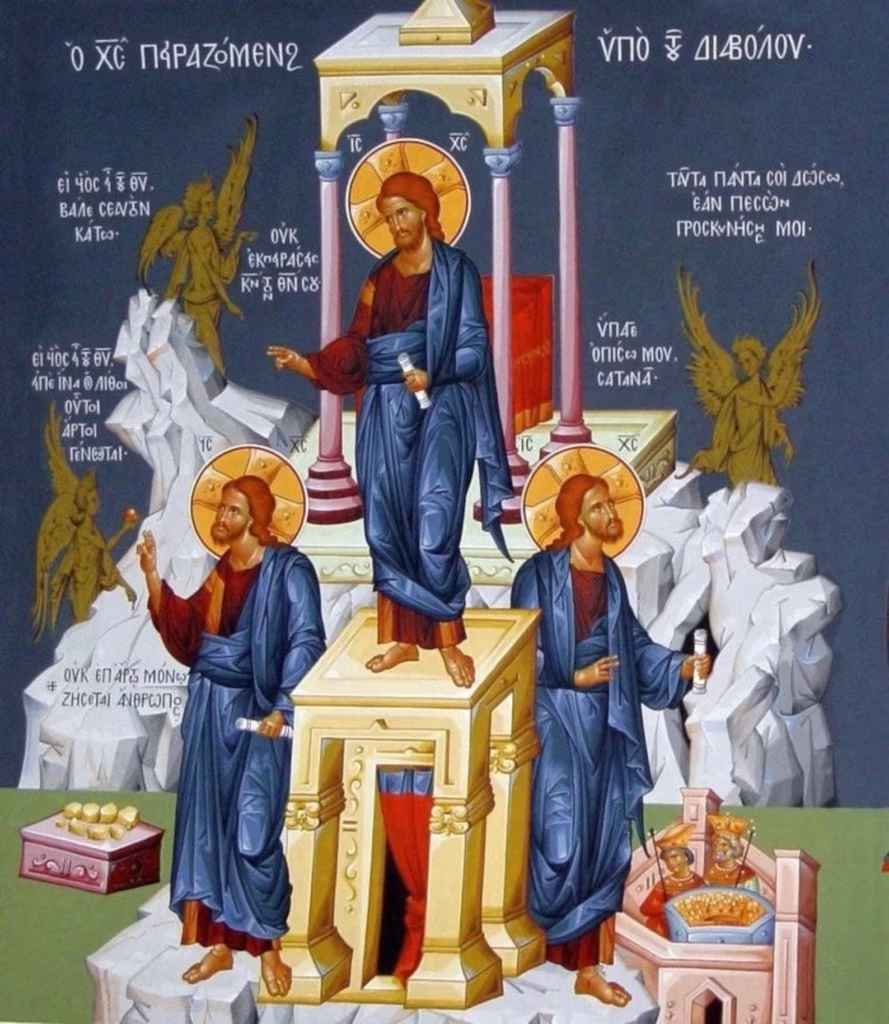
Christ’s response — “Man shall not live by bread alone, but by every word that proceeds from the mouth of God” — is the foundation stone of the Great Lent. Fasting is not the rejection of the body; it is the reordering of the body’s desires under the lordship of the spirit. St. John Chrysostom reminds us that Adam fell through eating, and Christ begins His public ministry through fasting.2 The mouth that was the gateway of the Fall becomes, through fasting and prayer, the gateway of restoration.
As we begin our fast today, let us hear this word: our deepest hunger is not for bread but for communion with the Living God.
The Second Temptation: The Pinnacle and Presumption (vv. 5–7)
“If You are the Son of God, throw Yourself down.”
Now the devil quotes Scripture — twisting Psalm 91 into an instrument of spiritual pride. He invites Christ to test the Father’s faithfulness, to force a miraculous intervention, to make faith into spectacle.
This temptation strikes at the heart of our spiritual life. How often do we seek spiritual experiences, signs, consolations — not out of love for God, but out of a desire to feel assured, to be special, to be validated? The Fathers warn us against seeking extraordinary experiences in prayer and fasting. St. Ephrem the Syrian teaches that humility, not ecstasy, is the true mark of the Spirit’s indwelling.3
Christ responds: “You shall not tempt the Lord your God.” True faith does not demand proof. It rests in obedience, in hiddenness, in quiet trust — even when the Father seems silent.
The Third Temptation: The Kingdoms and Glory (vv. 8–10)
“All these things I will give You if You will fall down and worship me.”
Here the mask slips. The devil reveals his ultimate aim: to be worshipped. He offers Christ a shortcut to glory — the kingdoms of this world without the Cross. This is the deepest and most subtle temptation: to achieve God’s purposes by the world’s methods, to bypass suffering, to reign without first being crucified.
St. Athanasius teaches that the Cross was not an obstacle to Christ’s mission but its very centre. There is no crown without the Cross, no Pascha without the Great Lent, no resurrection without death to self.4
Christ’s rebuke is absolute: “Away with you, Satan! For it is written, ‘You shall worship the Lord your God, and Him only you shall serve.‘”
In this, Christ teaches us the grammar of the entire Lenten journey: single-hearted worship of God alone, the rejection of every idol — comfort, reputation, control, self-will — and the embrace of the narrow path that leads to life.
For Our Journey Today
As we begin this sacred season, let us take three lessons from our Lord’s victory in the wilderness:
The temptation of the body calls us to fast — not as punishment, but as liberation from slavery to appetite, reordering our desires toward God.
The temptation of presumption calls us to pray — not seeking signs, but resting in humble, hidden communion with the Father.
The temptation of worldly glory calls us to worship — giving our whole heart to God alone, renouncing every idol that competes for the throne of our soul.
Lord Jesus Christ, who conquered the tempter in the wilderness by the power of the Word and the Spirit, grant us grace as we enter this holy season. Strengthen our fasting, deepen our prayer, and purify our worship, that we may follow You through the desert of repentance to the joy of Your glorious Resurrection. By the prayers of the Theotokos and all the saints, have mercy on us. Amen.
- St. Isaac the Syrian, The Ascetical Homilies, Homilies 1, 37, 54 (Holy Transfiguration Monastery, 2011). ↩︎
- St. John Chrysostom, Homily 13 on the Gospel of Matthew, §2 (NPNF I/10) ↩︎
- St. Ephrem the Syrian, Hymns on Faith; Hymns on Virginity 12 (CUA Press, 2015; Paulist Press, 1989) ↩︎
- St. Athanasius, On the Incarnation, chapters 19–29 (St. Vladimir’s Seminary Press) ↩︎