Day 1: Eve, and the Debt Signed in Eden
And Adam called his wife’s name Eve, because she was the mother of all living. – Genesis 3:20
We are starting this fast in the worst possible place. That is deliberate.
Read Genesis 3 slowly this morning and watch what happens. The serpent talks. The woman listens. The fruit is taken. Their eyes open, and the first thing they see is that they have nothing on. Then God comes walking in the garden and the sentences are handed down. Enmity. Pain. Thorns. Sweat. Dust.
And then something happens that almost nobody notices.
Adam turns to his wife and gives her a name. He calls her (Eve) Life.
Think about when he does it. Death has just come into the world through her. The sentence has just been read out. They are minutes away from being put out of the garden. And at that exact moment he names her after the very thing they have lost. The text says nothing about how strange this is. It simply records it and moves on.
That name is a claim made against all the available evidence. Whatever else Genesis 3 is, it is not a chapter that has given up hope.
Our fathers noticed. What they did with it is probably not what you are expecting.
Not a story about a good girl and a bad girl
Most of us have heard Eve and Mary compared as a lesson in behaviour. Eve disobeyed, Mary obeyed, so be like Mary. That is not what the Syriac hymns are doing, and if you read them expecting it you will miss the whole thing.
They are describing a debt.
In one of the hymns on the Virgin, Eve sits down in Eden and signs a document. It is an IOU, a record of what is owed. And the serpent is the one holding the pen.
In Eden Eve wrote out
a mighty document of debt,
with the result that her children lamented,
for it brought death to generation after generation
The serpent, that perverse scribe,
in his guile wrote, signed and sealed it.
That primordial dragon
by his counsel made the debt vast
for the race that fell in love with the Captivator’s company,
by listening to the dragon
it caused Adam to leave the Garden.
– Sebastian Brock, Bride of Light: Hymns on Mary from the Syriac Churches, no. 27., v. 1 & 2, Pg. 92, Moran Etho 6 (Kottayam: SEERI, 1994).
Look at what the poet is doing with the serpent. He is not a tempter here, or a talking animal, or a symbol of anything. He is a clerk. He drafts the paperwork, he witnesses the signature, he applies the seal, and then he keeps the document. There is something colder and more frightening about that than about any monster.
And the debt gets passed down. Parent to child, generation to generation, all the way through the Old Testament. Everybody inherits it and nobody can clear it.
You will understand exactly how this works if you have ever known a family carrying a loan that somebody else took out.
Then, the hymn says, a girl from that same family line finally settles her mother’s account.
Eve’s sin contracted the debt
which was held in reserve for Mary,
so that the young girl might repay her mother’s debt,
and thanks to her that document would be torn up
which had cried out against all generations.
– Sebastian Brock, Bride of Light: Hymns on Mary from the Syriac Churches, no. 27, V.3, Pg. 92, Moran Etho 6 (Kottayam: SEERI, 1994).
That is not a morality tale. That is one legal transaction stretched across several thousand years. Saint Paul is where the image comes from, in his letter to the Colossians (2:14), where he says that the record of debt standing against us has been cancelled. The Syriac poets took that single verse and built the whole of salvation history into a courtroom.
Notice what they never say. They never call Mary the better woman. They call her the one who paid.
Two women, and both of them were asked
There is a second thing the hymns keep returning to, and it is easy to miss because it is so quietly made.
Both women were spoken to first.
One of the poets sets the two scenes side by side like a pair of photographs, and simply swaps the figures over.
Instead of the serpent, there stood Gabriel,
Instead of Eve, Mary the Virgin,
On that first occasion it was not a man who spoke
and because of this no male
was appointed to repay the debt.
– Sebastian Brock, Bride of Light: Hymns on Mary from the Syriac Churches, no. 26, V.9, Pg. 90, Moran Etho 6 (Kottayam: SEERI, 1994).
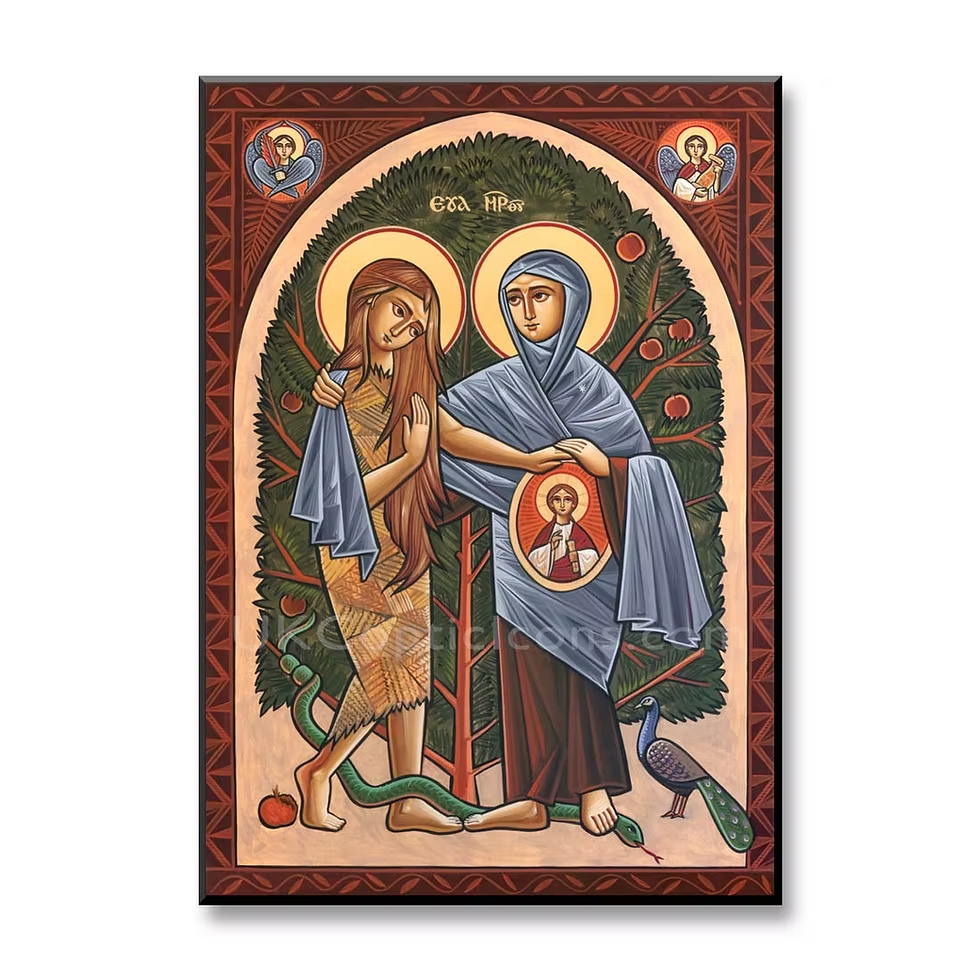
Same garden, in a sense. Same kind of moment. A messenger arrives, speaks, and waits.
Ephrem presses it further, and his version is stranger. He says that Life came in through the same door that death came in by: the ear.
Just as from the small womb of Eve’s ear
death entered in and was poured out,
so too through a new ear, that was Mary’s.
Life entered and was poured out.
– Sebastian Brock, Bride of Light: Hymns on Mary from the Syriac Churches, Pg. 6, Moran Etho 6 (Kottayam: SEERI, 1994).
That sounds odd if we take it as a piece of biology. It is not meant as biology. It is a picture, and what it is pointing at is the seriousness of listening. Nobody grabbed Eve and made her eat. Nobody grabbed Mary and made her pregnant. Both of them were talked to. Both of them answered. Both answers changed everything that came afterwards.
Here is the part I most want you to keep, especially if you are young and have ever felt guilty for having questions.
Mary did not simply say yes. Read Luke 1 and you will see she asked something first.
Then said Mary unto the angel, How shall this be, seeing I know not a man?
– Luke 1:34
She wanted to know how it worked. The angel did not tell her off for asking. He answered her. Only after that did she say, be it unto me according to thy word.
The difference between the two women is not that one had questions and the other did not. It is what each of them let in.
But she did not tear up the paper
Now the turn, and everything rests on it.
Mary did not cancel the debt. She could not. Nobody born inside a debt can clear it from the inside.
Look at where Saint Paul actually says the record was destroyed. It was nailed to the cross (Colossians 2:14). Not laid in the manger. The document was torn up at Golgotha, by her Son, at his own cost, more than thirty years after the angel came to Nazareth.
So how does she repay her mother’s debt? By giving birth to the one who repays it. The hymns say this openly whenever they are praising her most warmly.
Blessed are you, and most blessed, for in you
Eve’s curse was annulled from womankind.
In you the bill of debt was paid
that the serpent had written for all mankind,
for you have given birth to the Treasure
which gives endless benefit to all the world.
In you the Light shone out: the rule of darkness
was swallowed up and ceased.
– Sebastian Brock, Bride of Light: Hymns on Mary from the Syriac Churches, (Hymns on the Virgin Mary, no. 9), verse 4. Check page 48.
Read that verse carefully and we will see it turn under our hands. It begins by blessing her and it ends by naming what she gave birth to. Every one of these hymns does the same thing. They will not let her stand alone in the frame, and neither should we.
If we forget that, we have not honoured her. We have only flattered her, and she has never once asked to be flattered.
What today asks of us
Fifteen days is not long, but it is long enough to notice something.
The temptation of any fast is to think the work is in the going without. It is not. Not eating is just not eating. The work is in what we let ourselves hear once the noise has come down a little.
Eve heard something that sounded reasonable and agreed with it. Mary heard something impossible, asked how, and then agreed. Today is about which of those two we are.
There is one more image from the hymns, and I will leave it with you rather than explain it.
Two virgins have been there for humanity,
one the source of life, the other the cause of death:
in Eve death arose, but Life shone out through Mary.
The daughter gave support to her mother who had fallen,
and because she had clothed herself in fig leaves of shame
her daughter wove and gave to her a garment of glory.
– Sebastian Brock, Bride of Light: Hymns on Mary from the Syriac Churches, Bride of Light, Hymns on the Virgin Mary, no. 2, verse 9. Check page 36.
Fig leaves, sewn in a hurry by a frightened woman, and then a robe of glory woven for her by her own daughter.
That is where this fortnight is walking. Not a lecture about a woman who got it wrong. A daughter making clothes for her mother.
Today, take the twenty minutes you are not spending on something else and read Genesis 3 to the very end. Go as far as the cherub and the turning sword set at the gate.
Remember that this series finishes with that guard standing down.
Peace, O Lady, for through you the curse of old was lifted;
Peace, O Lady, for through you Adam was raised from the fall;
Peace, for the Lord is with you.
Your brother in Christ
Jobin