Day 1 – The Cloud Received Him
Ascension to Pentecost: The Season of Waiting
“He who descended to us in mercy now ascends in glory, carrying with Him the firstfruits of our nature. The angels marvelled to see the wounds still shining in that Body, for He did not leave behind what He had taken from us.”
– Jacob of Serugh, Memra on the Ascension (c. 500 AD)
There is a moment in the Ascension narrative that we too easily pass over.
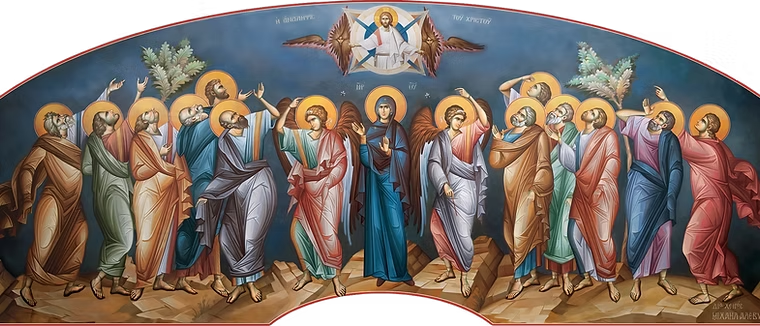
Luke tells us that as the disciples watched, Jesus was “lifted up, and a cloud received Him out of their sight” (Acts 1:9). And then they just stood there. Still looking up. Two angels had to come and gently interrupt them: “Men of Galilee, why do you stand gazing into heaven?” (Acts 1:11).
We might smile at that. But there is something deeply human in that upward gaze. These were not men staring blankly into the sky. These were men who had walked with Him, eaten with Him, touched the wounds in His hands after the Resurrection. And now He was gone, not dead, but gone. Taken into a cloud. What were they supposed to do with that?
Before we rush them back to Jerusalem, let us stand with them for a moment. Let us feel the weight of that cloud.
The Ascension Is Not a Departure
The first thing the Syriac Fathers want us to understand about the Ascension is this: it is not an ending, but a completion.
Jacob of Serugh, the great sixth-century poet-theologian of the Syriac Church, whom our tradition honours as the Flute of the Holy Spirit, wrote a magnificent memra (verse homily) on the Ascension that turns the whole event into a cosmic drama of wonder. He pictures the angelic hosts lining the heavens as Christ ascends, and they are astonished, not merely that He is returning, but at how He returns. He returns bearing humanity. He returns carrying the very flesh He took from the Virgin, now glorified, now radiant, and still marked with the wounds of the Cross.
Jacob asks us to see what the disciples could not fully see in that moment: that the Ascension is the Incarnation reaching its intended destination. God became human not merely to die for us, and not merely to rise for us, but to bring our nature with Him into the presence of the Father. The Body that was born in Bethlehem, that walked the roads of Galilee, that hung on the wood of the Cross – that same Body is now seated at the right hand of the Majesty on high.1
This is not an abstract theological point. It is the very ground of Christian hope. St. Paul, writing to the Ephesians, prays that they might know “the exceeding greatness of His power toward us who believe, according to the working of His mighty power which He worked in Christ when He raised Him from the dead and seated Him at His right hand in the heavenly places” (Ephesians 1:19-20). The power that raised Christ is the same power that is at work in those who are united to Him. The Ascension is the declaration that this union is permanent, that it has been carried into eternity, that the Son of God did not take our humanity as a temporary garment to be discarded once His work was done.
This is why our Fenqitho, the great treasury of West Syriac liturgical hymnody that forms the poetic backbone of our worship, speaks of the glorified Christ as bearing the “firstfruits of our nature” to the Father. In the ancient world, the firstfruits were not a mere symbol. They were the pledge and the foretaste of the whole harvest. When a farmer presented the firstfruits at the temple, he was declaring: what I bring now is the promise of everything that is to come. Christ’s ascended, glorified humanity is the firstfruits of ours. He did not leave us behind. He went ahead, carrying us with Him.2
This is why the Feast of the Ascension is, liturgically, a feast of joy rather than of sorrow.
What the Wounds Mean
Jacob’s image of the wounds still visible in the glorified Body deserves to be held a little longer, because it is not simply poetic decoration. It is a profound theological statement.
The Resurrection did not erase the wounds. The Ascension did not erase them either. When St. Thomas, the Apostle was invited to touch those wounds (John 20:27), he was touching something that has now been carried into eternity. The marks of the nails, the mark of the spear – these are not blemishes that will one day be removed from the glorified Body. According to our tradition, they are His glory. They are the signs of what Love looks like when it goes all the way.

St. Ephrem the Syrian, writing in the fourth century, reflects on the mystery of Christ’s glorified Body with characteristic wonder. For Ephrem, the wounds of Christ are not the remnants of suffering but the trophies of victory, the visible testimony inscribed upon the Body of the Son of God that He was here, that He suffered, that He overcame. They are the seal of the covenant written not in ink but in flesh. In his Hymns on the Resurrection, Ephrem meditates on how the risen and ascended Body carries within itself the whole history of salvation, the whole story of God’s descent into the human condition, now permanently woven into the fabric of the glorified humanity that sits at the Father’s right hand.3
For us, this is not a distant theological abstraction. It speaks directly to every person who carries wounds of their own, wounds of grief, of failure, of illness, of loss. The Ascension does not promise us that our wounds will be erased. It promises us something more startling: that our wounds, surrendered to Him, can be transfigured. That what was broken can be made luminous. That He who ascended still bears the marks of His suffering, and He bears them in glory.
The Oriental Orthodox tradition has always held firmly to this theanthropy, this full union of divinity and humanity in Christ, against every impulse to spiritualise the Incarnation away. The Council of Ephesus (431 AD) and the witness of our Fathers in the tradition of Alexandria and Antioch both insist: He who ascended is truly and fully human, as truly as He is truly and fully divine. The cloud that received Him did not receive a divine being who happened to be wearing a body. It received the God-Man, the one Person in whom two natures are united without confusion, without change, without division and without separation – and that union is everlasting.
Why They Were Redirected Earthward
The angels’ question – “Why do you stand gazing into heaven?” – is not a rebuke. It is a reorientation.
The disciples had been given a task. “You shall be witnesses to Me,” Christ had said, “in Jerusalem, and in all Judea and Samaria, and to the end of the earth” (Acts 1:8). The gaze into heaven was natural, even holy. But it could not remain there. The Ascension does not call the Church to a wistful spirituality of longing for what has departed. It calls the Church to a forward spirituality, one of expectant, active, earthward waiting.
There is an important distinction here that our tradition holds carefully. Waiting, in the Christian life, is never passive. It is not the waiting of someone who has given up and sits in resignation. It is the waiting of a farmer who has sown his seed and tends his field, watching the horizon. It is the waiting of a watchman who does not sleep at his post. The disciples were redirected to Jerusalem, to community, to prayer, to the business of being the Church, before the Spirit came. The Spirit honours the prepared heart, the gathered body, the upturned face that is willing to stop gazing at where He went and start listening for what He promised.
This pattern of active, obedient waiting is deeply embedded in the Syriac spiritual tradition. Metropolitan Paulos Mar Gregorios, one of the great theologians of the Malankara Orthodox Syrian Church in the twentieth century, wrote of the Christian community as a Pentecostal community always in the process of becoming what it already is. The Church does not wait for the Spirit as though He has not yet come. She waits in the Spirit, and by that very waiting she is being formed, shaped, made ready for ever deeper outpourings of the divine life. The return to Jerusalem is not a retreat. It is the first act of the Church’s mission.4
A Word for the Indian Orthodox Faithful
In the Malankara Orthodox Syrian Church, the Ascension is counted among the twelve great feasts of the Lord. When we stand in the sanctuary and hear the priest chant the Ascension prayers from the Fenqitho, we are doing exactly what the disciples did. We are standing at the threshold between the visible and the invisible, between the world as it is and the world as it is being made.
The forty days after the Feast of Resurrection, that preceded this feast were days of resurrection joy. The disciples had spent them in the luminous company of the Risen Lord, receiving teaching, receiving peace, being reconstituted as a community after the shattering of the Passion. Now begins something different, nine days of a different kind of faith. Faith that rests not on visible presence, but on promise. Faith that looks not at the cloud, but at the word spoken before the cloud came.
This is, in miniature, the life of every Christian. We are all, in a sense, people who stand between the Ascension and Pentecost. We live in the time of the Spirit’s indwelling, post-Pentecost by calendar, yes. But in the interior life, in the life of discipleship, we are perpetually being called from gazing upward to returning to the Upper Room. Perpetually being called from nostalgia for past experiences of God to readiness for the new fire He wishes to pour out.
The cloud received Him. The disciples returned with great joy. And nine days later, the world changed.
We are in those nine days now.
For Reflection
- Where in my own spiritual life am I “gazing into heaven,” longing for a past experience of God, when I am being called to return to the Upper Room of prayer and community?
- What does it mean to me personally that Christ ascended without leaving our humanity behind? What does His glorified, wounded Body say to the wounds I carry?
- In what ways am I waiting actively rather than passively? What would it mean to prepare my heart as the disciples prepared theirs?
A Closing Prayer
O Lord Christ, who ascended in glory and carried our frail nature to the heights of the Father’s presence: teach us to stand not gazing where You have gone, but watching for what You have promised. You did not leave us orphans. You did not depart as one who abandons. You went as the Firstfruits go before the harvest, as the Forerunner enters before the procession. Grant us, in these days of holy waiting, a stillness that is not emptiness but expectation, a silence that is not absence but readiness. Let the cloud that received You become, for us, the cloud of Your presence, surrounding us, going before us, leading us toward the fire that is to come.
Through the intercessions of the Theotokos, the holy Apostles, and all the saints of the Syriac tradition, have mercy on us.
Amen.
This is the first of nine reflections for the days between the Feast of the Ascension and the Feast of Pentecost. Come, Holy Spirit.
References and Sources
- Jacob of Serugh (c. 451–521 AD) Memra on the Ascension (Syriac: Turgomo d-Suloqo). ↩︎
- The Fenqitho (Phenkeetho, the West Syriac Festal Breviary) ↩︎
- St. Ephrem the Syrian (c. 306–373 AD) Hymns on the Resurrection ↩︎
- Metropolitan Paulos Mar Gregorios (1922–1996) The Human Presence: An Orthodox View of Nature. Geneva: WCC Publications, 1978. Contains his theology of the Church as a Pentecostal community always becoming what it is.
Cosmic Man: The Divine Presence. New Delhi: Sophia Publications, 1980. Develops his understanding of theosis and the Spirit’s work within an Indian Orthodox framework. ↩︎