Day 2 – They Returned with Great Joy
Ascension to Pentecost: The Season of Waiting
“The mystery is not a closed door barring our entry. It is an open horizon drawing us forward. The soul that accepts it does not stand still. It walks deeper into the light it cannot yet fully see.”
– St. Ephrem the Syrian, Hymns on Faith, Hymn 32 (c. 350 AD)
I want to sit with one verse today. Just one.
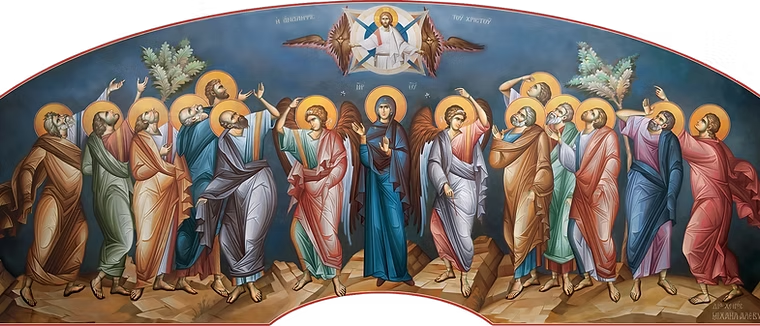
Luke 24:52. It follows immediately after the Ascension account, and if you read it too quickly you will miss how strange it is. The disciples, Luke tells us, watched Jesus ascend into heaven, were told by angels that He would one day return in the same manner, and then walked the two miles back to Jerusalem – with great joy.
With great joy.
Think about that for a moment. The one they had followed for three years, the one whose risen presence had filled the past forty days with a joy they had never before known, the one who had opened the Scriptures to them and breathed peace upon them and eaten broiled fish at their table, had just been taken from their sight. They did not know exactly when He would return. They did not know what Pentecost would bring, because Pentecost had not happened yet. They had a promise, and a command to wait, and nothing else they could see or touch or verify.
And they returned with great joy.
Joy That Outruns Understanding
This is the kind of joy that baffles the world. It is not the joy that comes from getting what we wanted. It is not the joy of resolution, of a tidy ending, of a story that has come to a satisfying close. The disciples’ story, from any external vantage point, was in pieces. Their teacher was gone. The authorities who had crucified Him were still in power. They were a small, largely uneducated group of people from the margins of the Roman Empire, gathering in an upper room, waiting for something they could not name.
And yet. Great joy.

St. Ephrem the Syrian spent much of his theological life thinking about exactly this kind of experience. His Hymns on Faith return again and again to the Syriac concept of rāzā, a word that is usually translated as “mystery” but carries more weight than our English word tends to suggest. For Ephrem, a rāzā is not simply something we do not yet understand. It is something that is real and active and present, even while it exceeds our comprehension. A mystery, in Ephrem’s sense, is not an absence of meaning but a superabundance of it. It is not a blank wall. It is a depth that keeps opening.1
The Ascension was a rāzā of this kind. The disciples could not have articulated a full theology of what had just happened. They could not have written the Epistle to the Ephesians on the spot, explaining the cosmic significance of the humanity of Christ now enthroned at the Father’s right hand. That understanding would come later, through the Spirit, through prayer, through years of reflection and suffering and witness. But the joy came first. Before the understanding, there was joy. And that sequencing is not accidental.
Obedience Before Explanation
There is a pattern running through the whole of Scripture that we tend to overlook because we are so conditioned to expect explanation before action. We want to understand before we commit. We want the full picture before we take the first step.
Abraham did not receive a map when he was called to leave Ur of the Chaldeans. He received a word: go. Mary did not receive a theological treatise on the Incarnation before the Annunciation. She received a question, a word of assurance, and then a call. And here, the disciples did not receive a briefing on pneumatology before being told to wait in Jerusalem. They received a promise and a direction.
Go back to the city. Wait. That is all.
And they went. And they were joyful.
Our tradition speaks of a quality of interior life that is difficult to capture in a single English word. It is not quite stillness, because stillness can suggest passivity. It is not quite tranquillity, because tranquillity can suggest detachment. It is something more like a settled, purposeful orientation of the whole person toward God – not restless, not second-guessing, not scanning the horizon for an alternative plan. The best image I have found for it is the river whose surface remains undisturbed even as its current moves with great purpose and power beneath. The water is not standing still. It is going somewhere. But it is not turbulent. 2
The disciples walking back to Jerusalem with great joy, without answers, without a visible Lord, without any certainty about what came next, embodied precisely this quality. They had given themselves, without reservation, to the direction of the One they trusted. And that trust produced something that looked, from the outside, like cheerfulness in the face of loss – but was, from the inside, something far deeper and far more costly than cheerfulness. It was the fruit of a will that had learned, through following, to rest in what it could not yet see.
The In-Between as a Place of Formation
One of the things I have come to appreciate in the Syriac spiritual tradition is the way it takes seriously what I can only call the in-between. So much of our spiritual energy goes into peak moments: the great feast days, the experiences of consolation in prayer, the clarity that sometimes descends on us during the Qurbana or in a quiet moment of reading. We treasure those moments, and rightly so. But the in-between, the ordinary stretch of days that connect one peak to another, tends to get treated as a kind of blank space, a pause before the next significant thing.

Ephrem rejects that interpretation. He believes that all of time is filled with God’s presence and purpose. Every moment matters and is not just a passage to another time. The nine days between Ascension and Pentecost are not just a break; they are a time of growth. The disciples weren’t just waiting in the Upper Room; they were being spiritually prepared for something they were not yet ready to receive.
This is a deeply consoling thought for anyone who feels, right now, that they are living in an in-between season. Perhaps you are between one chapter of life and another. Perhaps you have received a promise from God that has not yet been fulfilled, and the waiting is beginning to feel less like expectation and more like uncertainty. Perhaps your prayer life feels dry, your sense of God’s presence less vivid than it once was, and you are not sure whether you are growing or simply marking time.
The disciples on the road back to Jerusalem would have understood that feeling. But Luke’s note on their joy suggests that they had, somewhere in those forty days with the Risen Lord, absorbed something crucial: the in-between is not empty. It is where the work of preparation happens. It is where the soul is stretched to a capacity it did not previously have. You cannot pour the Spirit of Pentecost into a vessel that has not been enlarged by waiting.
What the Return to Jerusalem Means
The command to return to Jerusalem is worth pondering in its specificity. Not Galilee, where they might have felt safer among familiar surroundings. Not the open countryside, where they could have prayed in solitude and peace. Jerusalem. The city where Jesus had been crucified. The city where the authorities who had killed him were still in residence. The city that had, barely weeks before, been the site of the worst event any of them had ever witnessed.
Going back to Jerusalem required courage. It required the kind of obedience that does not wait for the feelings of confidence to arrive before taking the step. And it required community. Notice that they did not each return separately, each to find their own quiet corner of the city in which to await the promise. They went together. They found a room together. They prayed together. The return to Jerusalem is the first ecclesial act of the post-Ascension Church, and it is an act of corporate obedience undertaken in the absence of full understanding.

For the Malankara Orthodox faithful, this pattern is not foreign. Our liturgical life has always understood that the Church gathers not because each individual member is in a state of peak spiritual experience, but because the gathering itself is the context in which formation happens. We do not wait until we feel ready for the Qurbana to attend the Qurbana. We come because the Qurbana makes us ready. We do not wait until our prayer feels alive and warm to pray the morning and evening offices. We pray because the praying is what keeps the channel open, whether or not the feelings follow.34
The disciples did not wait to feel joyful before they returned. Luke tells us they returned and they were joyful. The obedience and the joy happened together. This is the Syriac tradition’s deep wisdom about the spiritual life: that the outward act of faithful response, undertaken even in the dark, carries within it a grace that the soul only recognises in retrospect.
A Word About Mystery
Before we close today’s reflection, I want to return to Ephrem’s concept of rāzā and say something that I think matters for how we enter these nine days of waiting.
We are, in the contemporary world, deeply uncomfortable with mystery. We want answers, and we want them quickly. We are not patient with processes we cannot monitor or outcomes we cannot predict. And this discomfort has a way of seeping into our spiritual lives, so that we find ourselves treating prayer as a mechanism for extracting divine responses, and the spiritual life as a project to be optimised, and faith as something we should be able to justify to a sceptic on demand.
Ephrem offers a different grammar altogether. He does not treat mystery as a problem to be solved. He treats it as a country to be inhabited. In his Hymns on Faith, he returns repeatedly to the image of the person who approaches divine mystery with the posture of a worshipper rather than an investigator, someone who is willing to be enlarged by what they cannot comprehend rather than diminished by it. Ephrem’s vision is of a person who approaches divine mystery not as an investigator measuring depths, but as one who surrenders to them and is carried.5
The hidden Essence humbles its investigator, but magnifies its worshiper.”
– St. Ephrem the Syrian, Hymns on Faith, 5:13
The disciples returning to Jerusalem with great joy were not people who had figured things out. They were people who had learned to trust the one who had. And that trust, practised over three years of following, had produced in them a capacity for joyful obedience that no amount of theological explanation could have manufactured.
That is what we are being invited into, in these nine days.
For Reflection
- Is there an area of our lives where we are waiting for understanding before we are willing to take the next step of obedience? What would it mean to take the step first?
- How do we experience the “in-between” seasons of our spiritual lives? Can we begin to see them not as empty waiting, but as active preparation?
- What does šawšyūṯā, this Syriac quality of settled, oriented stillness, look like practically in our daily rhythm of prayer and work?
A Closing Prayer
Lord, You sent Your disciples back to the very city where they had watched You die, and they went with great joy. We confess that we are not often so ready. We confess that we prefer understanding to obedience, clarity to trust, the visible to the promised. Teach us, in these nine days, the joy that comes not from resolution but from surrender. Teach us to live in the mystery of Your purposes without needing to reduce it to something we can manage. And grant us, as You granted them, the grace of returning: returning to prayer, returning to community, returning to the Upper Room of holy waiting, even when we cannot yet see what fire is being prepared to meet us there.
Through the intercessions of the Theotokos and all the saints, have mercy on us.
Amen.
Day 2 of 9 reflections for the days between the Feast of the Ascension and the Feast of Pentecost.
Patristic Reference
- St. Ephrem the Syrian Hymns on Faith (De Fide). The primary source for Ephrem’s theology of rāzā. ↩︎
- On Šawšyūṯā in the Syriac Tradition – The Syriac Fathers on Prayer and the Spiritual Life by Brock, Sebastian P. This anthology includes passages from multiple Syriac authors on interior stillness and its relationship to obedient prayer. ↩︎
- West Syriac Liturgical Theology. Aldershot: Ashgate, 2004 by Fr. Baby Varghese. Chapter 6 addresses the theology of communal gathering and corporate formation in the West Syriac eucharistic tradition. ↩︎
- The Eucharistic Liturgy of the Malankara Orthodox Syrian Church. Kottayam: MOSC Publication, 2003. ↩︎
- St. Ephrem the Syrian Hymns on Faith (De Fide). Source: the_hymns_on_faith_by_ephrem_the_syrian_jeffrey_wickes_z-lib.org_.pdf ↩︎