Syriac Christianity

  • Day 5 – The Ship Whose Cargo is God

    The Syriac Fathers gave the Blessed Virgin one of the most beautiful titles ever written:

    “Welcome, O Ship whose cargo is God.”

    She carried no earthly treasure.

    She carried the eternal Word made flesh.

    The One who steers the whole creation allowed Himself to be carried within His Mother’s womb so that the riches of heaven might reach the shores of humanity.

    Even today, this beautiful imagery continues to be sung in the Friday Vespers of the Shehimo in the Indian Orthodox Church.

    As we continue our journey through the Shoonoyo Fast, the question it leaves us with is simple:

    Are we waiting with open hearts to receive the Treasure that heaven has brought to us?

    📖 Read the full reflection on Seeking Theosis.

    “She is the ship. He is the Treasure.”

  • |

    The Undivided Light: The Holy Trinity (Part 6 of 7)

    He became human so that we might become divine.
    Athanasius of Alexandria wrote that in the fourth century, and it remains one of the most concentrated summaries of the entire Gospel ever written in a single sentence.
    This sixth post in the summer Trinity series is about theosis, participation in the undivided life of God, and why it is impossible to understand theosis without understanding the Trinity.
    Four fathers guide this post.
    Athanasius of Alexandria on the exchange at the heart of the Incarnation and why the Son had to be truly God for any of it to work.
    Cyril of Alexandria on participation through the Son and in the Spirit, and why the Eucharist is the primary sacramental locus where theosis takes place.
    Ephrem the Syrian, who said in seven words what takes Cyril several pages to establish: he gave us divinity, we gave him humanity.
    Severus of Antioch on the epiclesis as the Trinitarian structure of theosis made visible and enacted in real time, and why theosis is not a private spiritual experience but something that happens within the community of the Church.
    There is also a reflection on the Malankara Qurbana as a theotic event from beginning to end, which may change how you hear the communion prayers next Sunday.
    Week 6 is up now. Link in bio.

  • |

    The Undivided Light: The Holy Trinity | Introduction

    A new series begins on Seeking Theosis this Wednesday.

    After Pentecost, the Church enters what is perhaps the most demanding season of all: the season of learning to live inside the mystery that has been fully given to us. That mystery is the Holy Trinity.

    “The Undivided Light: The Holy Trinity” is a Wednesday summer study walking through Trinitarian theology as received and expressed in the Oriental

    Orthodox tradition, through the voices of Ephrem the Syrian, Jacob of Serugh, Cyril of Alexandria, Severus of Antioch, and the liturgical prayers of the Malankara Qurbana.

    Seven posts. Seven Wednesdays. One mystery that is not a problem to be solved but a life to be received.

    The introductory post is up now.

    And if you think of it, please pray for the writer as this series gets underway.

    To read the full blog –

  • |

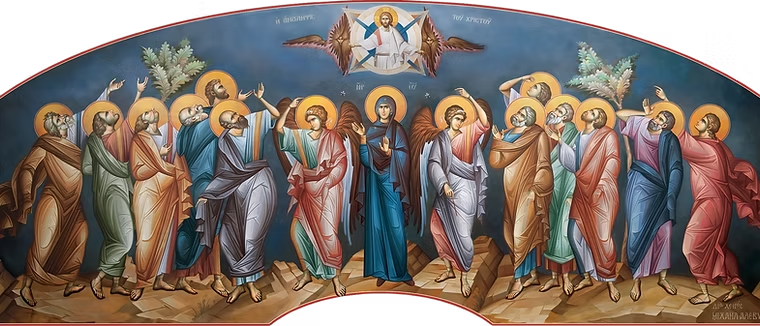
    Day 1 – The Cloud Received Him

    We begin today nine days of waiting, from the Ascension to Pentecost, and Seeking Theosis will be posting a short reflection for each of these days drawn from our Syriac Fathers and the liturgical tradition of our Church.

    Today’s reflection centres on a beautiful image from Jacob of Serugh: that when Christ ascended, He did not leave our humanity behind. He carried it with Him, wounds and all, to the right hand of the Father. The glorified Body that sits at the throne of the Majesty on high is still marked with the nails and the spear. Not as blemishes, but as glory.

    “He did not leave behind what He had taken from us.”

    That is the ground of our hope as we wait for the fire of Pentecost.

    You can read the full reflection here.

    Let us keep these nine days in prayer together.