Days of Waiting

  • |

    Day 9 – The Vigil Before the Fire

    We have arrived at the last night.

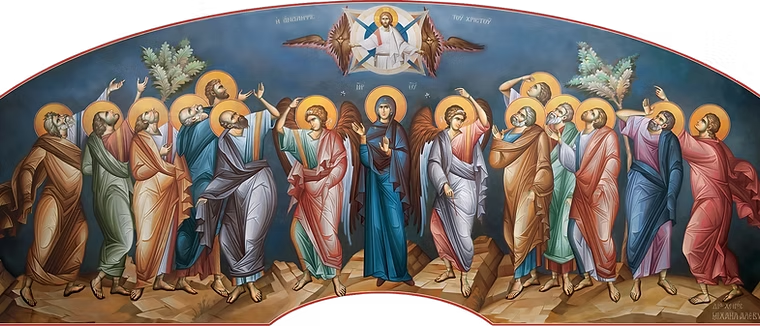
    Nine days ago, the disciples stood on the Mount of Olives and watched the cloud receive Him. They were redirected earthward, back to Jerusalem, back to one another, back to the Upper Room and the long, patient work of waiting for what had been promised.

    Tonight is the vigil. The last night of watching before the morning that will change everything.

    The parable of the ten virgins has been on my mind today. All ten had lamps. All ten intended to be there when the Bridegroom arrived. But five of them had not brought enough oil for a night that turned out to be longer than they expected. And while they were gone to buy more, the door was shut.

    The disciples in the Upper Room, by the ninth night of their waiting, had brought enough oil.

    Nine days of sustained prayer, one accord in supplication, the patient rebuilding of the Twelve, the reading of the Scriptures, the holding together of a community through every quality of waiting – dry and luminous, difficult and peaceful – had filled the lamps.

    They did not know that the Bridegroom was coming in the morning. But they had kept their lamps burning through the night.

    And when the morning came, they were found with oil.

    Stay awake tonight. The fire is very close now.

    Day 9 of 9. The vigil before the fire. Full reflection on the blog.

  • |

    Day 8 – Tongues of Fire Were Prophesied

    Days of Waiting – Day 8
    Today’s reflection sits with three prophetic texts that the Upper Room community would have been reading in those days of waiting: Joel’s promise of the Spirit poured out on all flesh, Isaiah’s vision of the Spirit resting on the shoot of Jesse, and Ezekiel’s extraordinary vision of the valley of dry bones.
    The image from Ezekiel has stayed with me most. The bones come together, bone to its bone. Sinew and flesh cover them. The structure is assembled. But there is no breath in them yet.
    The disciples in the Upper Room were, in a real sense, that valley. The community was gathered. The Twelve had been restored. The prayer had been sustained for eight days. But the breath had not yet come.
    One more day.
    The Syriac tradition holds that Scripture and Spirit are never separated. When we open these prophetic texts today, the same Spirit who inspired them is present in the reading. Joel’s promise, Isaiah’s vision, Ezekiel’s breath, these are not ancient words about a distant past. They are present words, addressed to us, now, one day before the fire falls.

  • |

    Day 7 – Mary in the Upper Room

    Day 7 of the Ascension to Pentecost series is live.
    Today we are sitting with Mary in the Upper Room. Acts 1:14 names her explicitly and separately, and Jacob of Serugh helps us understand why.
    At the Annunciation, the Spirit came to her alone. In the Upper Room, she prays that He might come to all.
    She is not a bystander at Pentecost. She is its intercessory heart.
    Two days until Pentecost. The fire is very close now.

  • |

    Day 6 – I Will Not Leave You Orphans

    Dear brothers and sisters, peace be with you.
    Day 6 of the series is now on the blog, and today we are sitting with the promise that Jesus made in John 14 before the Cross: I will not leave you orphans. I will come to you.
    The disciples in the Upper Room were living inside this promise on Day 6 of their waiting. They had no timeline. They had no picture of what was coming. They had only the word.
    One thing I have been sitting with today is the Syriac understanding of the Holy Spirit. In our liturgical language, the Spirit is Ruha d-Qudsha, and the feminine grammar of that word gave our Fathers a theology of the Spirit as brooding, maternal, generative. The same Spirit who hovered over the primordial deep at creation, who overshadowed Mary at the Annunciation, is the one the disciples were waiting for in the Upper Room.
    And the reflection connects this directly to the Epiclesis of our Qurbana. Every time the priest implores the Spirit to descend upon the gifts, we are standing in the Upper Room, holding out the promise of John 14 and asking for its fulfilment. The tradition is clear: that prayer is always answered. The Spirit always comes.
    We are three days from Pentecost in this series. The fire is closer than it was.

  • Day 5 – The Restoration of the Twelve

    Dear brothers and sisters, Day 5 of the series is now on the blog.
    Today’s reflection is on the election of Matthias, and one thought has stayed with me since writing it.
    Matthias is chosen to complete the Twelve. And then he disappears from the New Testament entirely. No recorded sermon, no miracle, no letter. He took the place that was given to him, served faithfully, and left no historical trace that we can find.
    The kingdom of God is not built only by the famous. It is built, day by day, by people whose names appear once and are not heard again, who showed up when they were needed and were content to be known only to God.
    Most of us are Matthias. And that is not a small thing.

  • |

    Day 4 – These All Continued with One Accord in Prayer

    Days of Waiting – Day 4

    Today’s reflection is on one word: homothumadon. One accord. The word Luke uses to describe the Upper Room community at prayer.

    One accord does not mean everyone feeling the same thing. It means many wills aligned toward a single purpose. Many faces turned toward the same horizon. The will choosing, day after day, to show up and wait, whether or not the feelings follow.

    Isaac the Syrian calls prayer the mother of all virtues. The Upper Room community was not generating the Spirit by their prayer. They were preparing the ground for Him to come.

    That is what our gathered prayer is for. To prepare the ground.

  • Day 3 – The Went Up Into the Upper Room

    Day 3: Ascension to Pentecost Reflections for the Days of Waiting
    “The Church is not a society of the perfect. She is a community of those who wait together for the perfection that only the Spirit can bring.”
    — Metropolitan Paulos Mar Gregorios
    A reflection on Acts 1:13-15, the Upper Room community of one hundred and twenty, and what the Indian Orthodox and Syriac patristic tradition teaches us about gathered, communal waiting as the context in which the Spirit chooses to work. From the Oriental Orthodox blog Seeking Theosis, rooted in the Malankara Orthodox Syrian Church and the Syriac patristic tradition.

  • |

    Day 2 – They Returned with Great Joy

    Day 2 of our Ascension to Pentecost series is now on the blog, and today I have been sitting with one of the strangest verses in Luke’s Gospel.

    After the Ascension, the disciples walked back to Jerusalem with great joy. Not after receiving explanations. Not after things had settled into clarity. With great joy, in the middle of the unknown, carrying nothing but a promise and a direction.

    Ephrem the Syrian teaches us that the hidden God humbles the one who tries to investigate, but magnifies the one who simply worships. The disciples had learned, through three years of following, to be the second kind of person. And that is what produced their joy.

    Today’s reflection asks us: what would it look like to return to our own Upper Room with that same quality of trust? Not waiting for feelings of certainty to arrive before we pray, before we gather, before we show up?

    The oil lamp does not wait until it feels ready. It simply burns.

    Come, Holy Spirit! Come!

  • |

    Day 1 – The Cloud Received Him

    We begin today nine days of waiting, from the Ascension to Pentecost, and Seeking Theosis will be posting a short reflection for each of these days drawn from our Syriac Fathers and the liturgical tradition of our Church.

    Today’s reflection centres on a beautiful image from Jacob of Serugh: that when Christ ascended, He did not leave our humanity behind. He carried it with Him, wounds and all, to the right hand of the Father. The glorified Body that sits at the throne of the Majesty on high is still marked with the nails and the spear. Not as blemishes, but as glory.

    “He did not leave behind what He had taken from us.”

    That is the ground of our hope as we wait for the fire of Pentecost.

    You can read the full reflection here.

    Let us keep these nine days in prayer together.